
Is Your Separation Agreement Enforceable?
The 4 Pillars of a Bulletproof Contract in Ontario
Kitchen table agreements get torn up in court. Here’s how to draft a contract that actually holds up under Family Law Act scrutiny.

LEGAL STRATEGY REVIEWED BY
Deepa Tailor, Principal Lawyer
Updated January 2026 to reflect Family Law Act s. 56(4) requirements.
Too Busy to Read? The 30-Second Answer:
Formalities: Must be in writing, signed by both parties, and witnessed (FLA s. 55(1)).
The “Killer” Clause: Agreements can be set aside if there was failure to disclose significant assets or if one party did not understand the consequences (Lack of ILA).
Enforcement: To enforce support payments through the FRO, the agreement must be filed with the court (Form 26B).
The “Kitchen Table” Trap
“Many couples draft an agreement on a napkin to ‘keep lawyers out of it.’ Years later, one party sues, and the judge tears that napkin up. Here is how to draft a contract that actually holds up.”
We see it every month: A couple sits down at their kitchen table, divides their assets “fairly,” writes it all down, signs it, and thinks they’re done. No lawyers. No drama. Just two adults being reasonable.
Fast forward three years. One party remarries. The other loses their job. Someone discovers a hidden RRSP. Suddenly, that “reasonable agreement” is in front of a judge—and it gets shredded.
Why? Because Ontario’s Family Law Act has strict requirements for what makes a separation agreement enforceable. Miss one, and your contract becomes expensive toilet paper.
This guide breaks down the 4 Pillars that separate a bulletproof contract from a lawsuit waiting to happen.
The Formalities (The Easy Part)
Under Section 55(1) of the Family Law Act, a domestic contract must meet three basic requirements:
In Writing
No verbal agreements. No text messages. No emails.
Signed by Both
Both parties must physically sign the document.
Witnessed
Each signature must be witnessed (Family Law Act, s. 55(1)).
Case Law: Docherty v. Catherwood
While courts sometimes relax these rules in the interest of fairness, they prefer strict compliance. Don’t gamble on judicial mercy—follow the formalities.
Bottom Line: These are the table stakes. If you don’t have these three elements, you don’t have a contract. But having them doesn’t mean your agreement is safe…
Financial Disclosure (The Foundation)

“You cannot agree to divide the pie if you don’t know how big the pie is.”
This is where most “kitchen table agreements” fall apart. Section 56(4)(a) of the Family Law Act states that a court may set aside a domestic contract if:
“A party failed to disclose to the other significant assets, or significant debts or other liabilities, existing when the domestic contract was made.”
Translation: If you hide assets, the contract is voidable. Period.
What Counts as “Significant”?
Bank Accounts & Investments
RRSPs, TFSAs, stocks, bonds, cryptocurrency
Real Estate
Primary residence, cottages, rental properties, vacant land
Business Interests
Ownership stakes, partnerships, professional corporations
Pensions & Deferred Compensation
Defined benefit plans, stock options, bonuses
Debts & Liabilities
Credit cards, lines of credit, tax debts, business loans
The Protection Strategy
We require clients to exchange Form 13.1 Financial Statements (the same form used in court) before signing any agreement. This creates a paper trail proving full disclosure was made.
Real Talk: Even if you “forgot” about an old RRSP or didn’t think your spouse’s pension mattered, a judge won’t care. Ignorance is not a defense. Disclose everything.
Independent Legal Advice (The Shield)
This is the most misunderstood requirement—and the one that saves agreements from being set aside.
“ILA isn’t just ‘getting advice’—it’s Duress Insurance.”
Under Section 56(4)(b), a court can set aside an agreement if:
“A party did not understand the nature or consequences of the domestic contract.”
Translation: If you sign something you don’t understand, you can claim you were taken advantage of—unless you had Independent Legal Advice (ILA).
What ILA Actually Does
Proves Understanding
A lawyer explains every clause, every consequence, and every right you’re giving up. You can’t claim ignorance later.
Prevents Duress Claims
It proves you weren’t pressured, coerced, or manipulated into signing. Your lawyer is your witness.
Identifies Unfairness
A good lawyer will flag clauses that are unconscionable or violate public policy before you sign.
Creates a Paper Trail
Your lawyer signs a Certificate of Independent Legal Advice that gets attached to the agreement.
Critical Rule: No Shared Lawyers
Each party should have their own lawyer. ILA is not a legal requirement (Family Law Act, s. 55(1)), but using the same lawyer to “save money” creates a conflict of interest and means there is no truly independent advice. The agreement becomes vulnerable to being set aside.
What Your ILA Lawyer Should Cover
Your rights under the Family Law Act (what you’re entitled to vs. what you’re getting)
The financial implications of each clause (property, support, pensions)
Whether the agreement is fair or unconscionable
The consequences of signing (finality, waiver of rights, enforceability)
Alternatives to the proposed agreement
Bottom Line: ILA is not a formality—it’s your insurance policy against a future lawsuit. Skip it, and you’re gambling with your financial future.
Don’t Miss a Clause
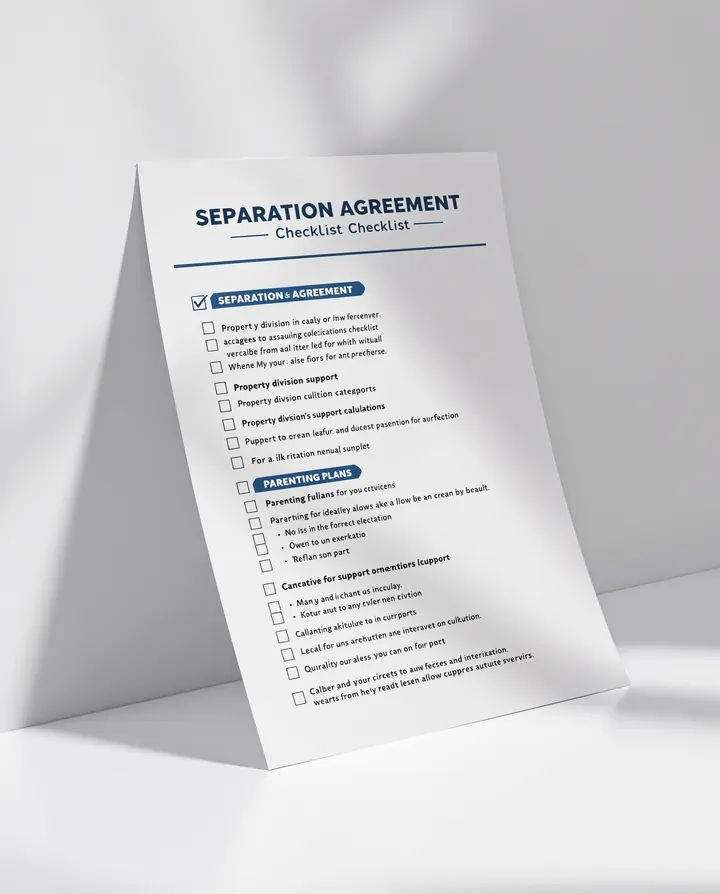
Download our comprehensive Separation Agreement Checklist to ensure you’ve covered Pensions, Debts, Parenting, and every critical detail.
- Property Division Checklist
- Support Calculation Worksheet
- Parenting Plan Template
- Financial Disclosure Guide
Filing & Enforcement (Making It Real)
You’ve got a signed agreement with full disclosure and ILA. Congratulations—you have a valid contract. But here’s the catch:
“A contract is just a piece of paper until it’s filed with the court.”
Why Filing Matters
Under Section 35 of the Family Law Act, you can file your separation agreement with the court. Once filed, its support provisions can be enforced as if they were a court order (Family Law Act, s. 35(1)).
FRO Enforcement
The Family Responsibility Office can garnish wages, seize tax refunds, and suspend licenses if support isn’t paid.
Contempt Powers
Violating a filed agreement can result in contempt of court charges—including potential jail time.
How to File
Complete Form 26B
Affidavit for Filing Domestic Contract or Paternity Agreement
Attach the Original Agreement
Include all schedules, certificates of ILA, and financial statements
File at the Court
Submit to the Ontario Superior Court of Justice in your jurisdiction
Enroll with FRO (Optional)
For automatic support payment enforcement
Do You Have to File?
No—but if your agreement includes child or spousal support, filing gives you enforcement teeth. Without filing, you’d have to sue for breach of contract (expensive and slow).
Changing the Deal (Variation)
Life changes. Incomes drop. Kids grow up. Can you change your separation agreement?
It depends on what you’re trying to change.
Can Be Changed
- Child Support: Always subject to variation based on income changes
- Spousal Support: Can be varied if there’s a “material change in circumstances”
- Parenting Arrangements: Can be changed if it’s in the child’s best interests
Usually Final
- Property Division: Final and binding (except in cases of fraud or non-disclosure)
- Equalization Payments: Cannot be reopened once paid
- Waiver Clauses: If you waived spousal support, it’s very hard to undo
What is a “Material Change”?
To vary support, you need to prove a material change in circumstances that was not anticipated when the agreement was signed. Examples:
Job loss or significant income reduction (not voluntary)
Serious illness or disability
Remarriage or new common-law relationship (for spousal support)
Child’s needs change (special education, medical expenses)
Pro Tip: Build in Review Clauses
Smart agreements include automatic review dates (e.g., “Spousal support will be reviewed after 5 years”). This avoids costly variation motions later.
Frequently Asked Questions
Can we use the same lawyer to save money?
NO. This is one of the most dangerous mistakes couples make.
Using the same lawyer creates a conflict of interest and means neither party has truly independent legal advice. If one party later claims they didn’t understand the agreement, the court will likely set it aside because there was no true ILA.
Each party MUST have their own lawyer. This is non-negotiable if you want an enforceable agreement.
Can a judge overturn our agreement?
Yes, but only in specific circumstances:
- Unconscionability: If the agreement is so unfair that it “shocks the conscience of the court”
- Non-Disclosure: If significant assets or debts were hidden
- Lack of Understanding: If one party didn’t have ILA and didn’t understand what they were signing
- Best Interests of the Child: Child support and custody provisions can always be reviewed if they don’t serve the child’s best interests
This is why following the 4 Pillars (formalities, disclosure, ILA, and filing) is critical—it makes your agreement nearly bulletproof.
Do we have to go to court?
No. That’s the whole point of a separation agreement—it keeps you out of court.
A properly drafted separation agreement is a private contract between you and your spouse. You don’t need a judge to approve it (unless you want to file it for enforcement purposes).
However, if you want the enforcement powers of a court order (wage garnishment, FRO involvement), you can choose to file it with the court using Form 26B. This is optional but highly recommended for support provisions.
What if my spouse won’t sign the agreement?
If your spouse refuses to sign, you cannot force them. A separation agreement requires mutual consent.
Your options:
- Negotiation: Work with lawyers or a mediator to find middle ground
- Mediation/Arbitration: Use alternative dispute resolution
- Court Application: If negotiation fails, you’ll need to go to court for orders on property, support, and custody
How long does it take to draft a separation agreement?
It depends on complexity and cooperation:
- Simple cases: 2-4 weeks (no kids, minimal assets, both parties agree)
- Complex cases: 2-6 months (business valuations, pensions, custody disputes)
The timeline is driven by: financial disclosure exchange, negotiation rounds, ILA appointments, and revisions. Rushing this process is dangerous—take the time to get it right.
Can we write our own agreement without lawyers?
Technically, yes—but it’s extremely risky.
Even if you draft your own agreement, both parties should still get Independent Legal Advice before signing. Without ILA, the agreement is vulnerable to being set aside.
Common mistakes in DIY agreements:
- Missing mandatory clauses (pension division, tax implications)
- Vague language that leads to disputes later
- Unconscionable terms that a judge will strike down
- Failure to address future contingencies (remarriage, income changes)
Our advice: Have a lawyer draft it. The cost of fixing a bad agreement later is 10x the cost of doing it right the first time.
Draft It Right, or Don’t Draft It at All
A separation agreement is not a formality—it’s a legally binding contract that will govern your financial life for years. Don’t gamble with kitchen table drafts.